Social Movement + New Social Movement + Environmental Movement

300_3

As in Timothy Doyle’s book and as we discussed in class, there are three categories of people’s movements: (i) Social Movement, (ii) New Social Movement, and (iii) Environmental Movement. As per the discussion in class and as per Manuel Castelle’s lecture give an example of each category summarizing briefly the main cause & characteristics of each of the examples you will discuss.


Environmental Movements Framework

331_3

Timothy Doyle suggested a framework to unpack and understand different environmental movements. Select one environmental movement from any country in the world and explain its history, how did it start, the key players, what is it’s main cause and its impacts on making the needed change. Make sure you use the framework stating clear the nation, issue banner, and campaign.

Note: Do not select any of the 6 examples Timothy Doyle used in his book.


History of Environmental Alteration

300_2

Based on the lecture and discussions in class, identify the main milestones discussed through the different eras. Select the most significant two in your own views and describe them in further details explaining the reasons of their importance.

Your response should be 1½-2 pages, typed, Times New Roman, 12 font, 1.5-spaced. It shall be posted on the class blog.


Environment: History & Evolution

331_2

At early times of their existence, humans altered the environment and with time their impacts started to increase. Based on the lecture and discussions in class, summarize briefly the tope milestones of major change in the evolution of development processes and its direct impact on the environment. Highlight where we, as humans, did good or bad to the environment and which is the best era/milestone, that we were less harmful to the environment.


Introduction to Class & You’re your vision statement

300_1

As an environmentalist with a purpose, objective and commitment to the environment, and using your previous knowledge and experience, write in no more than 150 words your vision statement for the environment. Describe how do you envision the environment and what is your role and environmental expert in the field.  ‪


Introduction to Class & Your understanding of the Global Env. Crisis

331

What do you know about Global Environmental Crisis and what does it mean to you? Where do you see the world heading and what can be done to save the environment? What is your role as an environmentalist in fixing the global environmental crisis or at least reduce its impacts?

In no more than 150 words, and as an environmentalist or an environmental advocate, provide your views on the above questions and highlight what it takes to reverse the Global Environmental Crises and have a sustainable future for the coming generations.


Environmental Planning in a Capitalist Economy: How advertising can be used in nature’s favor | By: Kelsey A. Wilson

EPPagesFinal_Page_01_

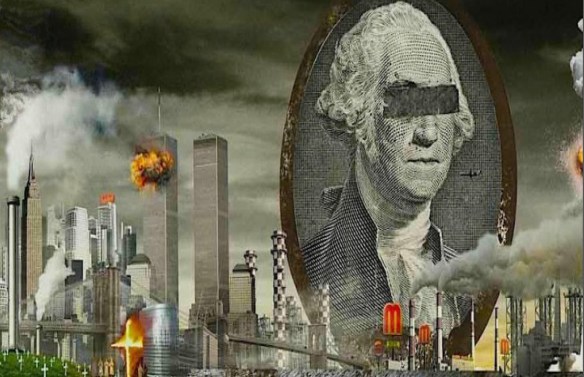
This project is inspired by Ad Busters, a self-proclaimed group of “artists, writers, musicians, designers, poets, philosophers and punks trying to pull off a radical transformation of the current world order”. The group was founded in Canada in 1989 after a large logging corporation ran advertisements in favor of clear cutting old growth forests. The founders of Ad Busters created the concept of the “uncommercial” and attempted to broadcast advertisements that were against the logging industry. Ad Busters began to advocate for changing the way people receive information and created a magazine, “uncommercials”, art and writing that expressed the concepts and ideas of anti-consumerism.

Although not specifically focused on environmental issues, the groups work regarding the economy overlaps with principles in the environmental field. The art work tackles the concepts of greenwashing and corporation’s control over the flow of information to consumers. Non-profits and other groups that advocate for environmental and social justice issues rarely have the time, money or power to have their message heard with the same force as large corporations. Ad Busters attempts to bridge this gap through their poignant, yet powerful messages.

From the readings and discussion in this class, the author has come to the conclusion that two of the major contributing factors to continued environmental degradation is capitalism as economy and the lack of education surrounding environmental issues. Let us not forget that there are other economic systems that could be implemented. It is our job as environmental stewards and people of integrity to demand changes. The status quo cannot be maintained. The continued pressure to create and consume has detrimental effects on the human psyche, the ecological systems and the stability of the human race.

Capitalism is multifaceted and these writings and analysis will focus on the aspect of advertising as a tool of the capitalist economic system. Using the tool of advertising to defeat consumerism; beat it at its own game by using “environmental advertising” as a way to educate people who do not understand the real life implications of consumerism.

For a full copy of the report click here

A New American Geography | By: Zak Dinh

EP_03_Page_01

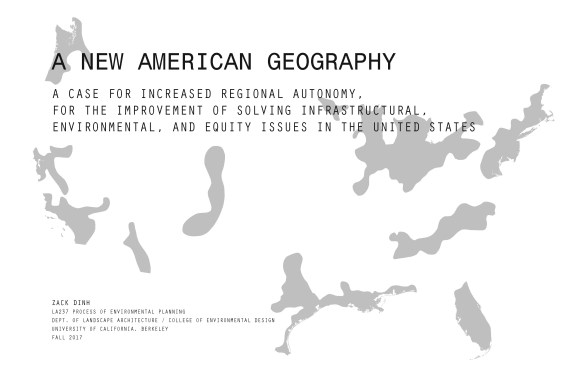
America’s status as the number one nation on Earth is waning. Americans are working harder than ever, yet our prosperity is declining. The idealization of more prosperous past has been growing, its manifestation and most recognizable slogan “Make America Great Again” is largely a glorification of mid-20th century America. A nuanced perspective is that America during that era contained inequality, racism, and environmental degradation: issues that have always underlined American history, and continue to be issues today.

However, ther|e is some truth to the idealization of this time period. The mid-20th century marked major milestones in American history. This was an optimistic era. America had not only survived the Great Depression but also became the de facto world leader at the end of World War II. These events saw the growing strength and consolidation of power at the Federal level. Importantly, trust in America, in the Federal system of government was high.

The mid-20th century was a time where the support for the federal government, and general post-war optimism generated the support for large-scale, government led initiatives aimed to improve the quality of life in America. The New Deal (1933), Federal Housing Administration (1934), Social Security (1935), Federal Aid Highway Act (1956), Environmental Protection Agency (1970), and other federal initiatives were decisive acts that improved the quality of life in America.

A bulk of these programs were focused on the construction of public infrastructure: roads, transit systems, water, power, utility infrastructure, public amenities like national parks, and housing projects. The vision of this era was to build the America of the future. Today’s current landscape, the suburbanized landscape of single-family homes connected by highways is the result of these programs.

Federal programs had monumental influence for the development of the United States and led to the prosperity for a large segment of Americans. However, to make clear, these programs were not at all successful in elevating the lives of all Americans. Today, America is divided, as America always has been. The concentration of poverty in both urban and rural areas of the country is the result of failure in federal policy. The segregation of Americans by race and income is a result of failure in federal policy.

This brief explanation of American history is to introduce several conclusions. First, those who feel nostalgia for a former grand era of America, have some factual basis for their perspective; this being that the primary cause for the success of this era was the large-scale federal spending on programs and infrastructure projects that the American people benefited greatly from. In summary, government investment of this nature leads to positive impacts for the American people.

Today, the Federal government is a shell of its former self and Americans are receiving diminishing gains from the Federal system. The consolidation of power at the Federal level has reached a point where differences in political ideology has stagnated the process of improving prosperity in the America. The Federal government today lacks the vision to invest in the American people and landscape. Increasingly, local, region, and state governments have been forced to tackle issues with diminishing support from the federal government.

For a full copy of the report click here
Equity Considerations for Environmental Planning | By: Julia Branco

EnvPLAN dec. 7_Page_01

This project analyzes selected articles addressing various topics in the environmental planning field. It then provides a critical perspective of the discussed topic through an equity and social justice lens. Given my interest in international planning, my analysis applies the analyzed topics by drawing on international examples, particularly in Latin America. Equity is understood as the just and fair inclusion into a society in which all can participate, prosper, and reach their full potential. Given the complexity of environmental planning and the scaling impact its outcomes have, it is important to consider if the processes and benefits of environmental planning are being distributed fairly.

For a full copy of the report click here

Marginal Gains in Environmental Planning | By Alaina Lipp

Alaina Lipp EPP Report_Page_01

Challenges facing our society’s relationship with the natural world are myriad and imminent. Environmental planners stand at a crucial juncture between man’s historical impacts, society’s current needs, and the needs of future generations. The environmental planner operates within a series of challenges – imperfect information about the nature of this world, insufficient authority to mandate and enforce, and the limit of historical observance of the actions and impacts of humanity’s development to guide intervention. With all of these things to take account of, it’s difficult but necessary to interrupt the cycle of perpetual analysis and make the leap into ac􀆟 on.

We cannot succeed if we do not risk failure. Now that the consequences of the industrial revolution are being felt we cannot wait until we have the most perfect, affordable, equitable, absolute solutions. We should apply any treatments that have a reasonable chance at success and then learn from that success or failure and try again. It’s difficult not to feel the gravity of this responsibility and become paralyzed into inaction, but the only certainty is that if we do nothing and continue to live and impact our planet as we do now our species will go extinct. If one looks at our current situation as a zero sum game, any action that helps society in the right direction is a good action, even if it isn’t perfect.

This report follows the concepts and material covered in the Fall 2017 offering of Environmental Planning Process at the College of Environmental Design and takes them a step or two further. The goal is to ask questions that will stimulate further investigation and generate thesis topics as well as generate suggestions for actions that can be taken by private individuals, educational institutions teaching landscape architecture, and research and publication topics where more investigation is warranted.

To obtain a copy of the report, click here.