Environmental Planning & Urban Land Use Planning | By: Kaiyuan Li

ep-final-report-kaiyuan_page_01.jpg

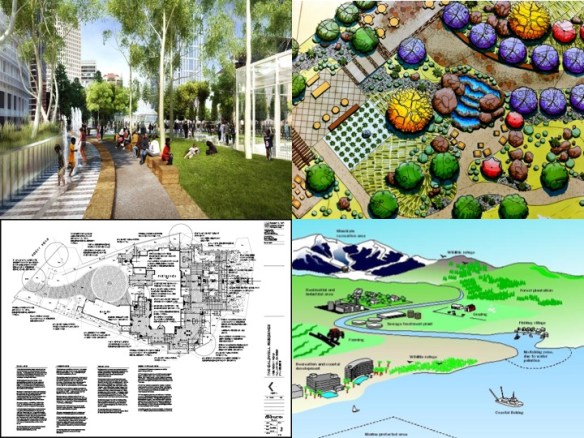
Environmental planning aims at promoting land development with considerations of natural environment, economic, social and political factors to achieve sustainable outcomes. This course draws from theory, history, ecological process, policy and real-life projects to construct a critical analysis of the role of environmental planning, its influences and potential impacts. The final report of this class combines the weekly assignment based on different issues for every week, such as water management and environmental injustice, with a clear stated thesis of urban land use planning which is of personal interest.

For a full copy of the report click here.

The Distance Between Reality and Ideality | By: Lulin Zheng

LA134A_FinalReport_LulinZHENG_Page_01

The distance between reality and ideality always exists in all kinds of environmental planning issues. This report is the result of a semester thought and discussion in LA 237 ‘The Process of Environmental Planning. In this semester, we have got through topics like ‘History of Environmental Planning, ‘Environmental Movements’, ‘City Vs Country: The Urban-Rural Continuum’, ‘Urbanization & Deforestation’, ‘Social & Spatial Justice’, ‘Climate Change & Sound Land Use Planning’, ‘Environmental Considerations in the City of Berkeley & UC Berkeley Campus’, ‘Regional & Inter-state Environmental Planning’, ‘National Environmental Planning System – NEPA’, ‘The Role of the Landscape Architect’, etc. All those topics are relevant to the health and survival of social-ecological system and particularly emphasizes on the problems in reality and how to achieve ideality by solving those problems (Adger, W. N. & Hodbod, J, 2007). Through the discussion, one thought came in to my mind that the distance between reality and ideality always existed in all kinds of environmental planning topics. The inter-state environmental planning is inevitable if we want to solve the environmental conflicts between resource states and effected states. But in reality, the powerless of environmental legal system and scientific evidence impede the inter-state environmental confliction solving process (Hall, N. D., 2008).

Environmental Justice is the ultimate goal of environmental planning.

After we discussed about the topic ‘Social & Spatial Justice’, I realized that according to the definition of social justice (Harvey, D, 2008), most people around the world fighting for environmental protection set the environmental justice as their ultimate goal. For example, the social movement cannot be divorced from the injustice distributional pattern in resources usage and waste production (Doyle, T., 2005). They fight for fair distribution of resource and environmental emission. NEPA and CEQA empower public to challenge the health hazard projects, which boost the fairness of public participation (https://soapboxie. com/social-issues/Nepa-v-Ceqa). All of those environmental protection action aims to environmental justice – equitable distribution of environmental ‘goods’ and harms, fair participation in all levels of environmental planning (Bell, K., 2014)..

Realizing the distance between reality and ideality would help us adjust strategies for future development. Hence, realizing the distance between reality and ideality would help use find the future trends of environmental planning. Since we know that the gap between reality and ideality will be along with us for a long time. We have to find a way to mitigate this gap by knowing what extent we have achieved in environmental justice.


Designing “our urban realm” for the Future | Radhika Haridas

Radhika Haridas-REPORT 120717_Page_01

Module (1)

This module takes a look at how cities were formed, the role of industrialization in city formation and how the agglomeration of population in such cities could possibly manage and reduce the harm done to the natural environment. It looks at the history of environmental planning, before industrial revolution and analyses the cities of London, New York and Shanghai in terms of the 3E’s of Sustainability – the social, economic and environmental – as a scale to define the city- before, and after industrialization or Industrial Revolution.

Module (2)

This module looks at the contemporary challenges faced by society with respect to the environment it is part of, such as – social resiliency, urbanization process & deforestation, social justice, climate change & land-use planning, environmental labeling & certification. The module dives into each topic through studying and analysing various case-studies which have been selected as an example of solving the issue of concern, through urban design/management strategies.

Module (3)

This module looks at decision makers at the local, regional and national scale who’s decisions are important in the decision making of whether or not a development should be allowed, depending on the extent of their impact on the environment. This module describes the role of the City of Berkeley and the University of Berkeley as the two main forces of decision making in the local scale. It looks at the tri-state environmental commission of New York-New Jersey-Connecticut on the regional scale and impact assessment tools of NEPA and CEQA at the national scale.

Module (4)

This module is a look at the roles of various people in the field of design and others who are in a position to influence the way we live today. It analyses their professional abilities and the change they can bring to planning for a better, sustainable future. As the last module of this report, this module tries to draw conclusions at who is at power of changing the way people live today, for better.

For a full copy of the report click here.

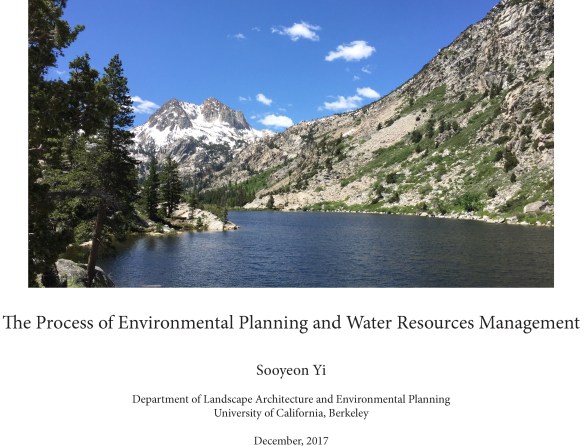
Process of Environmental Planning and Water Resources Management | By: Sooyeon Yi

sooyeon_yi_fin5_page_01.jpg

This project covers the lectures, readings, and other course material in The Process of Environmental Planning course in Fall, 2017. The topics of each week was not limited to the United States, but also looked at different countries, especially in South Korea. Then, as coming from hydrology and water resources management background and growing interest in river restoration topic, the author further explored on each topic from hydrology stand point of view. For each topic, the author reflected on three components: blog post extension, example from South Korea, and stream management perspective. The objectives are to summarize key points from each lecture, reflect on the author’s culture and background, and reevaluate from hydrologist perspective.

I grew up reading cartoons, a lot. I believe comics make an integral part of newspapers that convey messages or express public opinion immaculately. Therefore, the cartoon is a primary feature in this project that provides added message or information that is not provided by the contents. In most cases, the purpose of cartoons in this project is to add humor and sarcasm or commentary on social changes, success, failure, and major contemporary events.

For a full copy of the report click here

The Sustainability Debate

____Picture1

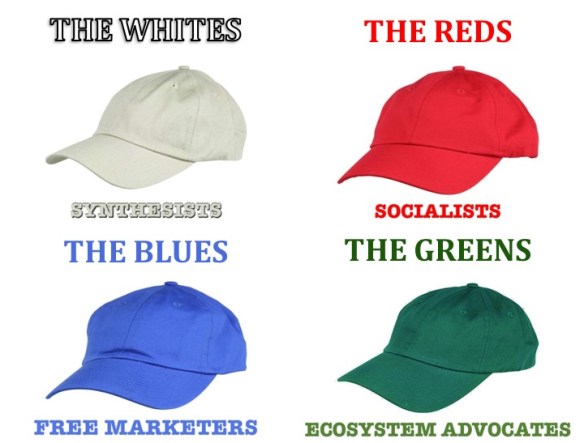
The Blues are mainstream free-marketers. Such people have a positive bias toward the future based on technological optimism and the strength of the economy. They are armed with a strong statistical case, based on the vigorous and dynamic economies of Western and (until1998) Asian nations. Their approach is deeply rooted in conventional economics, and their number-crunching reveals a world vastly improved and rapidly ascending. Blues believe that reliance on innovation, investment, and individual freedom will ensure a shining future for humankind, and a level of material well-being that has strong appeal to virtually everyone in the world. Their optimism also extends to the environment, believing that in most cases, markets will send strong and appropriate price signals that will elicit timely responses, mitigating environmental damage or causing technological breakthroughs

The Reds represent the sundry forms of socialism. Although one might expect them to have been discredited by the downfall of the Soviet Union, their worldview is very much alive. They find validation in the chaotic and horrific economic conditions that the rise of bandit capitalism has brought to contemporary Russia, a country whose economic machinery now benefits a minority at the expense of a materially and socially disadvantaged majority. The growing and worldwide gap between rich and poor confirms the Reds’ analyses, which are as accurate about poverty and suffering as the Blues’ observations are accurate about growth and change. While Blues focus on the promise of growth and technology, Reds focus on its shadow and try to discern its root causes. They view labor—one aspect of human capital—as the principal source of wealth and see its exploitation as the basis of injustice, impoverishment, and ignorance. The Reds generally have little to say about the environment, seeing it as a distraction from fundamentally important social issues.

The Greens see the world primarily in terms of ecosystems, and thus concentrate on depletion, damage, pollution, and population growth. They focus on carrying capacity and want to bring about better under- standing of how large the economy can grow before it outstrips its host. Their policy focuses on how many and how much, the number of people, and the amount of impact each person can have upon the environment. Greens are not usually technophobes; most see technology as an important tool to reduce human impact. More recently, some have become interested in free-market mechanisms, and want externalities presently borne by society to be fully integrated into producer costs and consumer prices so that markets become, in David Korten’s phrase, “mindful.” The Greens, and to some extent the Reds, host bigger tents in that they hold a bolder and broader diversity of views. But this also keeps them splintered and self-canceling, as Greens tend to unite their enemies and divide their friends, a good formula for political failure. They are often portrayed as caring less for people than animals, more about halogenated compounds than waterborne diseases.

The Whites are the synthesists, and do not entirely oppose or agree with any of the three other views. With an optimistic view of humankind, they believe that process will win the day, that people who tell others what is right lead society astray. Since Blues, Reds, and Greens all fall into that category, Whites reject them all, preferring a middle way of integration, reform, respect, and reliance. They reject ideologies whether based on markets, class, or nature, and trust that informed people can solve their own problems. On the environmental level, they argue that all issues are local. On business, they say the fabled level playing field never existed because of market imperfections, lobbying, subsidies, and capital concentration. On social problems, they argue that solutions will naturally arise from place and culture rather than from ideology. Leadership in the White world is reminiscent of the Taoist reminder that good rulers make their subjects feel as if they succeeded by themselves. Environmental and social solutions can emerge only when local people are empowered and honored.


According to your assessment of the “Pink Lake Development Plan” and based on the debate discussion in class. Summarize, in half a page, the main point of strength in the group you presented and the main point of weaknesses in one of the other groups that you fundamentally disagree with.    

#Env_Plan  
 

The Role of the Landscape Architect

____Picture1

Between the “Declaration of Concern” in 1966 and the “New Landscape Architecture Foundation Declaration” in 2016, lots have happened to the discipline. In the light of this transformation for the discipline, and in conjunction with the article titled “The Landscape Architects are the Urban Designers of tomorrow” describe, in 1 page, the current role of the Landscape architect and how do you see this transformation. Then in half a page summarize what do you agree or disagree in the contemporary role of the landscape architect.

#Env_Plan

Your speech on NEPA improvement

___Picture111111111

In facing the current unprecedented environmental challenges, imagine that the leaders of all environmental authorities on the federal level and state level gathered in a nationwide conference to brainstorm and improve the NEPA process. Participants include experts in the environmental affairs and politicians from federal, state and county government.  You are selected as a Berkeley graduate from the MLA/EP program to give a one-page speech to shed the light and improve a specific step or two in the NEPA screening process. What will you write in this speech? Try to be as solid, specific, coherent as you can and feel free to incorporate an example if it can demonstrate your ideas and convince them to make the change you are requesting.

‪#Env_Plan


Regional & Inter-state Environmental Planning

sipfinalso2img4The discussion in class covered different aspects of Regional & Inter-state planning. Based on this discussion and your own readings write a page shedding the light on: (i) what do you think inter-state planning actually means? (ii) Why the examples mentioned in the readings good/bad and (iii) provide suggestions to improve the objectives and mandates for such inter-state planning.

Collaborative planning emerged from both theory and practice. Experience shows that participation remains problematic and less effective than we, as environmental planners, would desire. Mandarano highlight the differences between the output and outcome in such a process. In one-page support or critic Mandarano’s approach and end with one example form the US or the world (of your choice) where the quality of people’s participation made a difference in accepting, rejecting or reshaping a mega project.

#Env_Plan

Environmental Considerations in the City of Berkeley & UC Berkeley Campus

__Picture1

Your 1st Page:

Aaron’s presentation (and Todd too) highlighted significant environmental factors influencing and shaping the built environment in Berkeley. For example: zoning; building heights; open views; sustainability; downtown development; ride sharing; how some projects of economic values can be justified despite their environmental impacts; (A) to (F) continuum of traffic/movement flow; . . . and urban management. In one page, (i) pick two of the of the most significant factors in your views and provide a critical overview on what you like or dislike about them, (ii) can they contradict the social and ecological values discussed in earlier classes, and (iii) what recommendations you may suggest to the city improve that.

__10_UCB_LRDP-CRP class

Your 2nd Page,

As a metaphor, Todd presented how the UC Berkeley is similar to Texas or DC. Aaron’s elaborated on that too. Explain how the campus planning overlap with the surrounding out-of-campus built environment. Elaborate on how the UC-Berkeley investment can have an impact on the downtown. Lastly, give one suggestion to improve this relationship.

#Env_Plan

In addition to the readings, the presentations can be found here:

Environmental Labels & Certificates

Green-Building-Labels-CS

Environmental labels and certificates are widely seen as a tool to provide greener buildings. Corporates, hotels and developers sought to achieve such certificates in varies level from bronze, silver, gold to platinum. In one page summarize the different critiques given by Abdalla et al 2011 and Tolksdorf et al 2014. In your 2nd page, and as per the discussion in class and the short video, explain where do you stand in relation to the usefulness of such certification system.

Strongly Agree

Agree Somehow Disagree Strongly Disagree
4 3 2

1

WHERE:

  • Strongly Agree (4): means you believe it is a step forward and better than nothing
  • Strongly Disagree (1): means you think it is useless and miss leading and many other un certified buildings equally green

Climate Change & Sound Land Use Planning

16313-climateshutterstock_news

Gondo (2013) presented several controversial ideas about climate adaptation using the Ethiopian model. At times, pp 88, he frames Ethiopia as a leading developing country in recognizing the importance of green infrastructure, and in other times, pp 91, he argues that urban planning authorities are less prepared to boost the resilience and adaptive capabilities of their cities. From the overall reading, in one page, discuss your own views on the importance inter-governmental cooperation and interdisciplinary approach to deal with climate change in urban & land use planning. In half a page /one paragraph, and according to Bohannon (2010), articulate the main challenges the Nile Delta is facing and suggest main three guiding principles to deal with challenges.

#Env_Plan