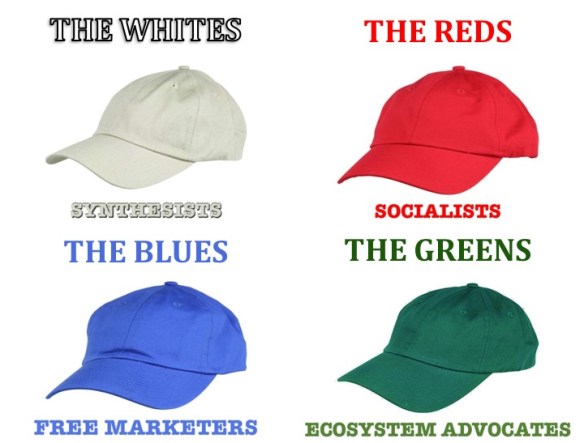
The Blues are mainstream free-marketers. Such people have a positive bias toward the future based on technological optimism and the strength of the economy. They are armed with a strong statistical case, based on the vigorous and dynamic economies of Western and (until1998) Asian nations. Their approach is deeply rooted in conventional economics, and their number-crunching reveals a world vastly improved and rapidly ascending. Blues believe that reliance on innovation, investment, and individual freedom will ensure a shining future for humankind, and a level of material well-being that has strong appeal to virtually everyone in the world. Their optimism also extends to the environment, believing that in most cases, markets will send strong and appropriate price signals that will elicit timely responses, mitigating environmental damage or causing technological breakthroughs
The Reds represent the sundry forms of socialism. Although one might expect them to have been discredited by the downfall of the Soviet Union, their worldview is very much alive. They find validation in the chaotic and horrific economic conditions that the rise of bandit capitalism has brought to contemporary Russia, a country whose economic machinery now benefits a minority at the expense of a materially and socially disadvantaged majority. The growing and worldwide gap between rich and poor confirms the Reds’ analyses, which are as accurate about poverty and suffering as the Blues’ observations are accurate about growth and change. While Blues focus on the promise of growth and technology, Reds focus on its shadow and try to discern its root causes. They view labor—one aspect of human capital—as the principal source of wealth and see its exploitation as the basis of injustice, impoverishment, and ignorance. The Reds generally have little to say about the environment, seeing it as a distraction from fundamentally important social issues.
The Greens see the world primarily in terms of ecosystems, and thus concentrate on depletion, damage, pollution, and population growth. They focus on carrying capacity and want to bring about better under- standing of how large the economy can grow before it outstrips its host. Their policy focuses on how many and how much, the number of people, and the amount of impact each person can have upon the environment. Greens are not usually technophobes; most see technology as an important tool to reduce human impact. More recently, some have become interested in free-market mechanisms, and want externalities presently borne by society to be fully integrated into producer costs and consumer prices so that markets become, in David Korten’s phrase, “mindful.” The Greens, and to some extent the Reds, host bigger tents in that they hold a bolder and broader diversity of views. But this also keeps them splintered and self-canceling, as Greens tend to unite their enemies and divide their friends, a good formula for political failure. They are often portrayed as caring less for people than animals, more about halogenated compounds than waterborne diseases.
The Whites are the synthesists, and do not entirely oppose or agree with any of the three other views. With an optimistic view of humankind, they believe that process will win the day, that people who tell others what is right lead society astray. Since Blues, Reds, and Greens all fall into that category, Whites reject them all, preferring a middle way of integration, reform, respect, and reliance. They reject ideologies whether based on markets, class, or nature, and trust that informed people can solve their own problems. On the environmental level, they argue that all issues are local. On business, they say the fabled level playing field never existed because of market imperfections, lobbying, subsidies, and capital concentration. On social problems, they argue that solutions will naturally arise from place and culture rather than from ideology. Leadership in the White world is reminiscent of the Taoist reminder that good rulers make their subjects feel as if they succeeded by themselves. Environmental and social solutions can emerge only when local people are empowered and honored.
According to your assessment of the “Pink Lake Development Plan” and based on the debate discussion in class. Summarize, in half a page, the main point of strength in the group you presented and the main point of weaknesses in one of the other groups that you fundamentally disagree with.
#Env_Plan
 The discussion in class covered different aspects of Regional & Inter-state planning. Based on this discussion and your own readings write a page shedding the light on: (i) what do you think inter-state planning actually means? (ii) Why the examples mentioned in the readings good/bad and (iii) provide suggestions to improve the objectives and mandates for such inter-state planning.



 In chapter 15 Tom Rough shared two ways in which urban growth derive deforestation. In conjunction with Barbara Torrey’s paper, describe these two drivers and, as expert in the field, how would you advise or suggests reforms to reduce this deforestation process. Also add few lines on urbanization factors that were not mentioned in the text. (in one page). In your 2nd page, and based on Roger Keil’s research about global cities network and the research presented in class by Ronal Wall, identify the top one or two social and/or economic factors in the city that you believe highly influence, shape and derive the spatiality and inter-urban network.

 Urban & Environmental Studies